Your AI Training Is Depreciating: The Half-Life Problem Every L&D Leader Needs to Understand
Apr 15, 2026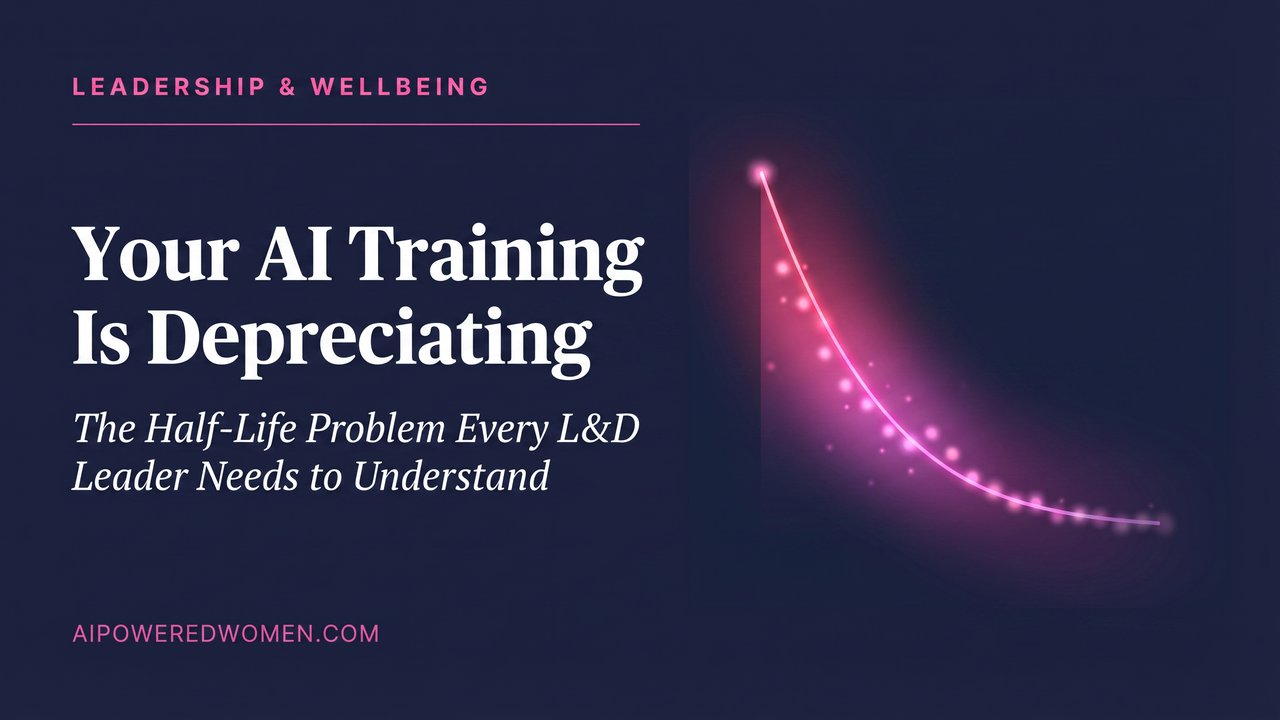
By Dr. Felicia Newhouse, Founder, AI-Powered Women
There is a number that should fundamentally change how every Chief Learning Officer thinks about AI investment. That number is 2.5 years. It is the approximate half-life of AI-adjacent professional skills, according to research from the IBM Institute for Business Value. In practical terms, it means that roughly half of what your workforce learned about AI tools and workflows in early 2024 has already lost its operational relevance.
This is a structural shift in how knowledge depreciates. For most of the 20th century, professional skills had a half-life of 10 to 15 years. By the early 2010s, that window had compressed to about five years. The acceleration from five years to 2.5 years is not gradual. It represents a qualitative change in what "training" means for knowledge workers, and it demands a fundamentally different approach to learning investment (IBM Institute for Business Value, 2024).
The Depreciation Math
Consider a straightforward scenario. Your organization runs an AI readiness program in Q1 2025. The curriculum covers prompt engineering patterns, integration workflows for copilot tools, evaluation frameworks for AI-generated outputs, and best practices for human-AI task allocation. At the time of delivery, the content is current and relevant.
By October 2025, the foundation models underlying your copilot tools have been updated twice. New integration patterns have emerged. The prompt engineering techniques that worked six months ago now produce inconsistent results with the updated models. The evaluation frameworks are still conceptually sound, but the specific failure modes they were designed to catch have shifted.
By April 2026, roughly 30 to 40 percent of the practical content from that Q1 2025 training has lost its direct applicability. The principles endure, but the specific techniques, the workflow patterns, and the tool behaviors that employees were trained on have moved.
This is the depreciation curve, and most organizations are not accounting for it.
The One-Time Training Trap
The World Economic Forum's 2025 Future of Jobs Report estimates that 59 percent of the global workforce will need reskilling or upskilling by 2030. That figure captures the scale of the challenge, but it understates the nature of it. The issue is not simply that workers need new skills once. It is that the skills themselves are depreciating faster than organizations can deliver them through traditional training models (World Economic Forum, 2025).
The dominant approach to enterprise AI training remains episodic. Organizations run a program, measure completion rates, report the numbers, and move on to the next initiative. The implicit assumption is that the knowledge delivered in that program will remain useful for years.
Dr. Peter Cappelli's research at the Wharton School tells a different story. His work on organizational learning and workforce development has consistently shown that organizations with continuous learning architectures retain 2.3 times more productivity gains from technology investments than those relying on periodic training events. The mechanism is straightforward: continuous systems adapt to changes in the technology environment. Periodic events freeze knowledge at the moment of delivery and begin depreciating immediately (Cappelli, 2024).
The financial implication is significant. If you treat a one-time AI training program as an investment, you need to depreciate it on your organizational balance sheet just as you would any other asset with a known decay rate. A $500,000 AI readiness program delivered in January 2025 is worth roughly $300,000 in operational value by January 2026. By mid-2027, it has depreciated to approximately half its original value. Yet most organizations carry the full value of that investment on their capability assumptions indefinitely.
What Continuous Readiness Actually Looks Like
The alternative to episodic training is not simply more training. It is a different architecture for how the organization develops and maintains AI capability over time.
A continuous learning architecture has four characteristics that distinguish it from the episodic model. First, it updates content in response to changes in the tool ecosystem rather than on a fixed calendar. When foundation models update, the learning system updates. When new integration patterns emerge, they are incorporated into the development curriculum within weeks rather than the next annual training cycle.
Second, it distributes learning across the workweek rather than concentrating it in multi-day events. Research on skill retention consistently shows that distributed practice produces more durable learning than massed practice. Forty-five minutes per week of applied AI skill development produces better long-term retention than a three-day workshop once per year.
Third, it emphasizes application over information. The components of AI readiness that depreciate fastest are specific techniques and tool behaviors. The components that depreciate slowest are evaluation judgment, workflow design thinking, and the metacognitive skill of knowing when AI is helpful and when it is misleading. A continuous architecture weights its investment toward the durable skills while keeping the perishable skills current through regular updates.
Fourth, it measures capability rather than completion. Completion rates tell you who sat through the program. Capability assessments tell you who can actually apply what they learned when the tools and the work environment change.
The Budget Conversation That Needs to Happen
If the half-life of AI skills is 2.5 years, then the L&D budget for AI readiness should not be structured as a one-time capital expenditure. It should be structured as an operating expense with a recurring allocation that accounts for the depreciation rate.
This is the conversation most CLOs have not yet had with their CFOs. The language of depreciation makes the case in terms finance leaders already understand. A one-time training program is a depreciating asset. A continuous readiness system is a compounding one. The organizations that will see sustained returns from their AI investments are the ones that match their learning architecture to the depreciation rate of the skills it develops.
This is central to the work we are building at AI-Powered Women. The AI Leadership Readiness Program is designed around the continuous development model, and the 2026 MIT Conference (September 12-13, Kresge Auditorium) will feature dedicated sessions on how enterprise organizations are restructuring their AI learning investment to match the pace of change in the technology itself.
The Question for Your Next Budget Cycle
Before your organization approves its next AI training investment, ask this: are we building a depreciating asset or a compounding one?
If the answer is a single program delivered once, you are building an asset that will lose half its value within 30 months. If the answer is a continuous system that evolves with the technology, you are building something that compounds. The difference between those two approaches will determine which organizations sustain their AI productivity gains and which ones find themselves retraining from scratch every two years.
The half-life clock is already running on every AI skill in your organization. The question is whether your learning architecture accounts for it.
References
IBM Institute for Business Value. (2024). The Enterprise Guide to Closing the AI Skills Gap. IBM Research.
World Economic Forum. (2025). Future of Jobs Report 2025. World Economic Forum.
Cappelli, P. (2024). Research on organizational learning architectures and technology adoption productivity. Wharton School, University of Pennsylvania.
Dr. Felicia Newhouse is the founder of AI-Powered Women and convener of the 2026 MIT Conference on AI Leadership Readiness (September 12-13, Kresge Auditorium, MIT). The AI Leadership Readiness Program supports enterprise organizations in building continuous AI capability development systems.
Join Us at the 2026 AI-Powered Women Conference
Connect with visionary women leaders, explore cutting-edge AI strategies, and grow your business at our flagship annual event. Don't miss out!